
Why Your 409A Is Lower Than Preferred Price [With Examples]
One of the most common —” and costly —” misconceptions among startup founders and CFOs is assuming that the 409A valuation should match the price investors pay for preferred shares. It shouldn't. Understanding this distinction is critical for issuing stock options correctly and staying IRS-compliant.
409A vs Preferred Price
Understanding the critical difference
Short answer: A 409A valuation is lower than your preferred share price because it measures the fair market value of common stock, which carries more risk and fewer protections than preferred shares — a gap of 25–60% is normal, expected, and required for IRS compliance.
A 409A common stock valuation is typically 25–60% lower than the preferred share price from your most recent funding round — and that gap isn't a mistake. The 409A measures fair market value of common stock under IRC Section 409A, while the preferred share price reflects what investors paid for senior shares with liquidation preferences, anti-dilution rights, board seats, and conversion rights that common stockholders don't get. The discount widens at seed (70–90% lower than preferred) and narrows pre-IPO (15–30%) as exit scenarios become more certain. Understanding this distinction is critical for issuing stock options correctly and staying IRS-compliant.
Understanding the difference between preferred share pricing and common stock fair market value is a core concept covered in our complete guide to 409A valuations for startups.
This article explains why 409A valuations are lower than preferred share prices, how the difference is calculated, and what founders and CFOs need to know in practice.
Once you understand why common stock is priced below preferred, get your 409A report free — expert sign-off for IRS safe harbor is just $499, using the same OPM methodology your auditors expect to see.
What Is a 409A Valuation, and What Does It Measure?
A 409A valuation determines the fair market value (FMV) of common stock for the purpose of granting stock options in compliance with IRS Section 409A. For a deeper dive into what a 409A valuation is, see our fundamentals guide.
It answers one specific question:
What would a willing buyer pay today for common stock, given the company's current risk, stage, and capital structure?
The valuation must reflect:
- Illiquidity
- Downside risk
- Preference structures favoring investors
This is why the result often surprises founders —” especially after a funding round.
What Is the Preferred Share Price, and Why Is It Different from FMV?
The preferred share price is the price investors pay in a financing round (Seed, Series A, Series B, etc.).
That price reflects:
- Negotiated terms
- Future upside expectations
- Liquidation preferences
- Protective rights and control provisions
In other words, preferred pricing is not a neutral market value —” it's a strategic investment price.
Why Are 409A Valuations Lower Than Preferred Share Prices?
1. Do Preferred and Common Shares Have Different Rights?
Preferred shares typically include:
- Liquidation preferences
- Participation rights
- Dividends
- Anti-dilution protections
Common shares —” the subject of a 409A valuation —” do not.
Because preferred investors get paid first in a downside scenario, common stock is inherently riskier and therefore worth less.
2. What Is the Illiquidity Discount in a 409A?
Common stock in a private startup:
- Cannot be freely sold
- Has no public market
- May take years to realize value
A 409A valuation must apply an illiquidity discount, reflecting the lack of exit options for common shareholders.
Preferred share prices do not include this adjustment.
3. How Is Risk Allocated Down the Capital Stack?
In a liquidation scenario:
- Creditors get paid
- Preferred shareholders recover capital
- Common shareholders receive what's left (if anything)
This risk hierarchy is mathematically reflected in a 409A valuation —” but not in the preferred share price.
4. How Does the Option Pricing Model (OPM) Calculate Common Stock Value?
Most early-stage startups use the Option Pricing Model (OPM) to allocate company value between preferred and common shares.
OPM models:
- Exit probabilities
- Volatility
- Capital structure
- Liquidation thresholds
The result is a discounted common share value relative to the preferred price —” often by 30—”70% in early stages.
This difference is not a loophole —” it is the expected outcome of a compliant valuation.
409A Valuation vs Preferred Share Price
"409A valuations reflect where common stock sits in the capital stack."
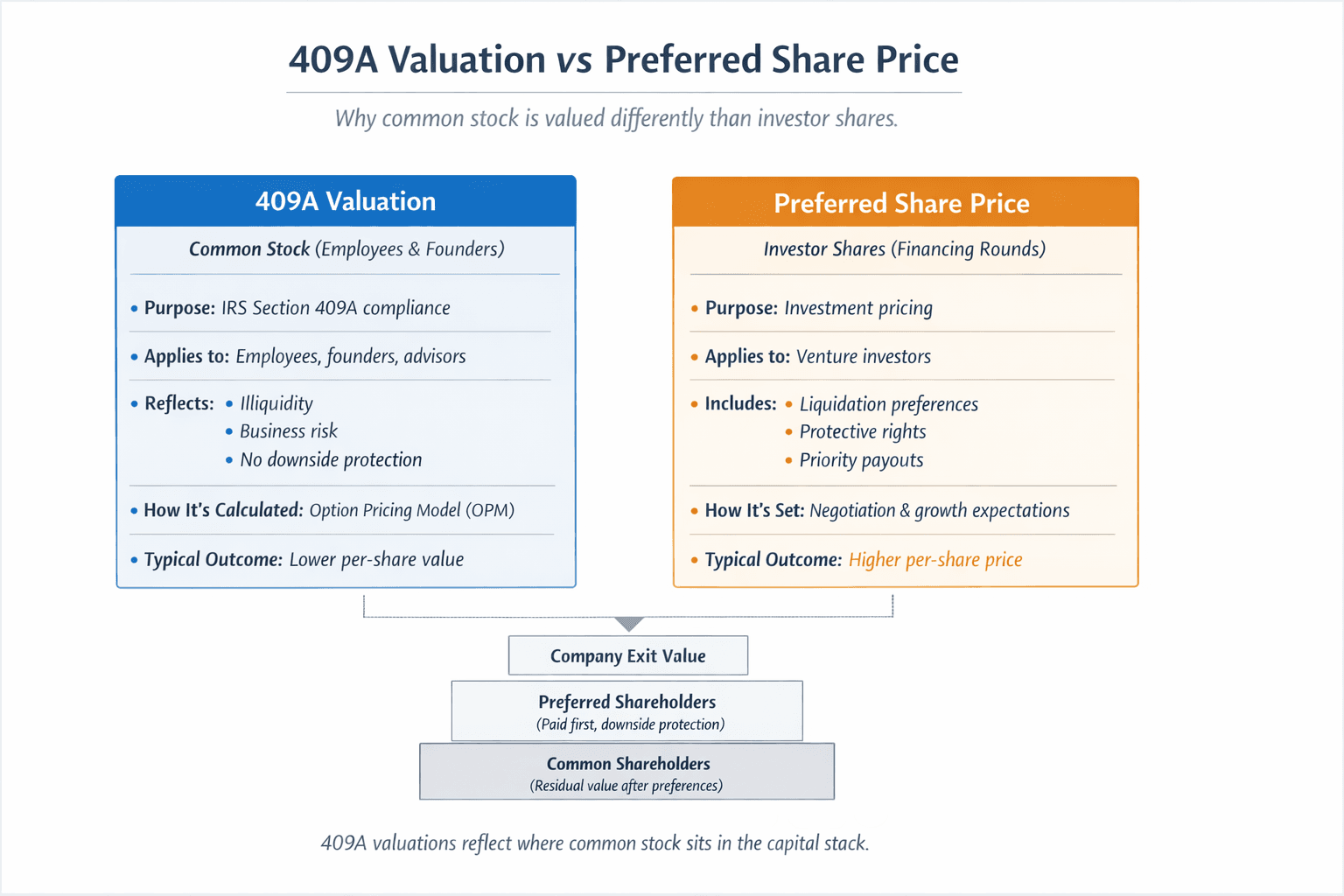
This difference is expected —” and required —” for IRS-compliant 409A valuation.
Why Does This Difference Matter for Founders and CFOs?
What Happens If You Issue Options at the Wrong Price?
If founders or CFOs assume the preferred share price equals FMV and issue options accordingly, they risk:
- Overpricing employee options
- Reducing equity incentives
- Creating retention issues
Worse, underpricing options below FMV due to incorrect assumptions can trigger:
- IRS Section 409A penalties
- Employee tax liabilities
- Loss of safe harbor protection
Do Investors Expect a Gap Between Preferred Price and 409A?
Experienced investors expect:
- Preferred share price ≠ common stock FMV
- A defensible, independent 409A valuation
- Clear documentation showing how value was allocated
If your 409A valuation is too close to the preferred price, that can actually raise red flags.
Common Founder and CFO Questions About the Gap
"Our Series A was priced at $2.00 per share —” why is our 409A only $0.60?"
Because:
- Preferred shares include downside protection
- Common shares absorb risk
- OPM allocates value based on exit scenarios
This gap is normal and expected.
"Can the IRS challenge a large gap between preferred price and 409A?"
Yes —” if the methodology is weak or undocumented.
No —” if the valuation is prepared by a qualified independent provider using accepted models.
"Does this gap shrink over time?"
Typically, yes.
As startups mature:
- Risk decreases
- Liquidity expectations improve
- Exit probability increases
Which narrows the spread between preferred and common values.
What Are the Best Practices for Founders and CFOs?
- Never assume preferred price = common FMV
- Know when to update your 409A valuation —” especially after financing rounds
- Ensure the valuation explains the allocation methodology
- Align option grants strictly with the 409A FMV
- Maintain board and audit documentation
What Should Founders and CFOs Remember About 409A vs. Preferred Price?
A 409A valuation and a preferred share price answer different questions for different audiences.
- Preferred pricing reflects investor expectations and negotiated protection
- 409A valuations reflect risk-adjusted fair market value of common stock
For founders and CFOs, understanding this distinction is essential to:
- Issue equity correctly
- Protect employees
- Maintain IRS compliance
- Avoid problems during audits, fundraising, or exits
Getting your 409A valuation right from the start sets the foundation for compliant equity compensation and smooth transactions down the road.
For a comprehensive look at all the different types of startup valuations —” including 409A, investor valuations, post-money, common stock, and exit valuations —” see our complete guide.
Related Questions
Why is common stock valued lower than preferred?
Common stock lacks the downside protection that preferred shares offer (liquidation preferences, anti-dilution, dividends). In a downside scenario, common shareholders receive value only after preferred shareholders are made whole, making common stock inherently riskier.
Does a funding round automatically change my 409A value?
A new funding round is considered a material event that typically requires an updated 409A valuation. However, the new 409A value won't simply equal the preferred price—it requires proper allocation analysis using OPM or PWERM methodologies.
When to update your 409A →What is the typical discount from preferred to common stock?
For early-stage startups, common stock is typically valued at 25-60% of the preferred price. The discount narrows as companies mature and approach liquidity events. The exact discount depends on the company's stage, capital structure, and exit probability.
How is fair market value calculated for 409A purposes?
409A valuations use methodologies like the Option Pricing Model (OPM) or Probability-Weighted Expected Return Method (PWERM) to allocate enterprise value between share classes, then apply a Discount for Lack of Marketability (DLOM) to reflect illiquidity.
Learn about OPM →Ready to Get Your 409A Valuation?
Get a compliant, defensible 409A valuation that properly allocates value between preferred and common shares.
Get Started Today