
The Different Types of Startup Valuations — and When Each One Matters
If you're a startup founder or CFO, you've probably encountered multiple "valuations" for your company — often with very different numbers. One comes from investors, another appears in a SAFE, and then a 409A valuation comes along with a much lower figure.
Startup Valuation Types
Understanding 409A, SAFE, Investor & FMV
Short answer: Startups have multiple valuations at once — a 409A for IRS compliance, an investor valuation for fundraising, and a post-money valuation for cap table math — and each serves a different purpose, so differences between them are normal and expected.
Startups have multiple valuations for different purposes — the preferred share price investors pay in a priced round, the 409A common stock FMV used to set option strike prices (typically 25–60% lower than preferred), the post-money valuation reported in press releases, and the fair value for ASC 718 stock-based compensation on the income statement. These numbers can differ by 2–3x and that's normal — each reflects a specific accounting or regulatory question, not a single “real” valuation. This article walks through which one matters when, and how each is calculated. This raises common (and valid) questions:
- Why are these valuations different?
- Which one is "real"?
- Which valuation actually matters — and when?
The short answer is this:
Startups don't have one valuation. They have different valuations for different purposes.
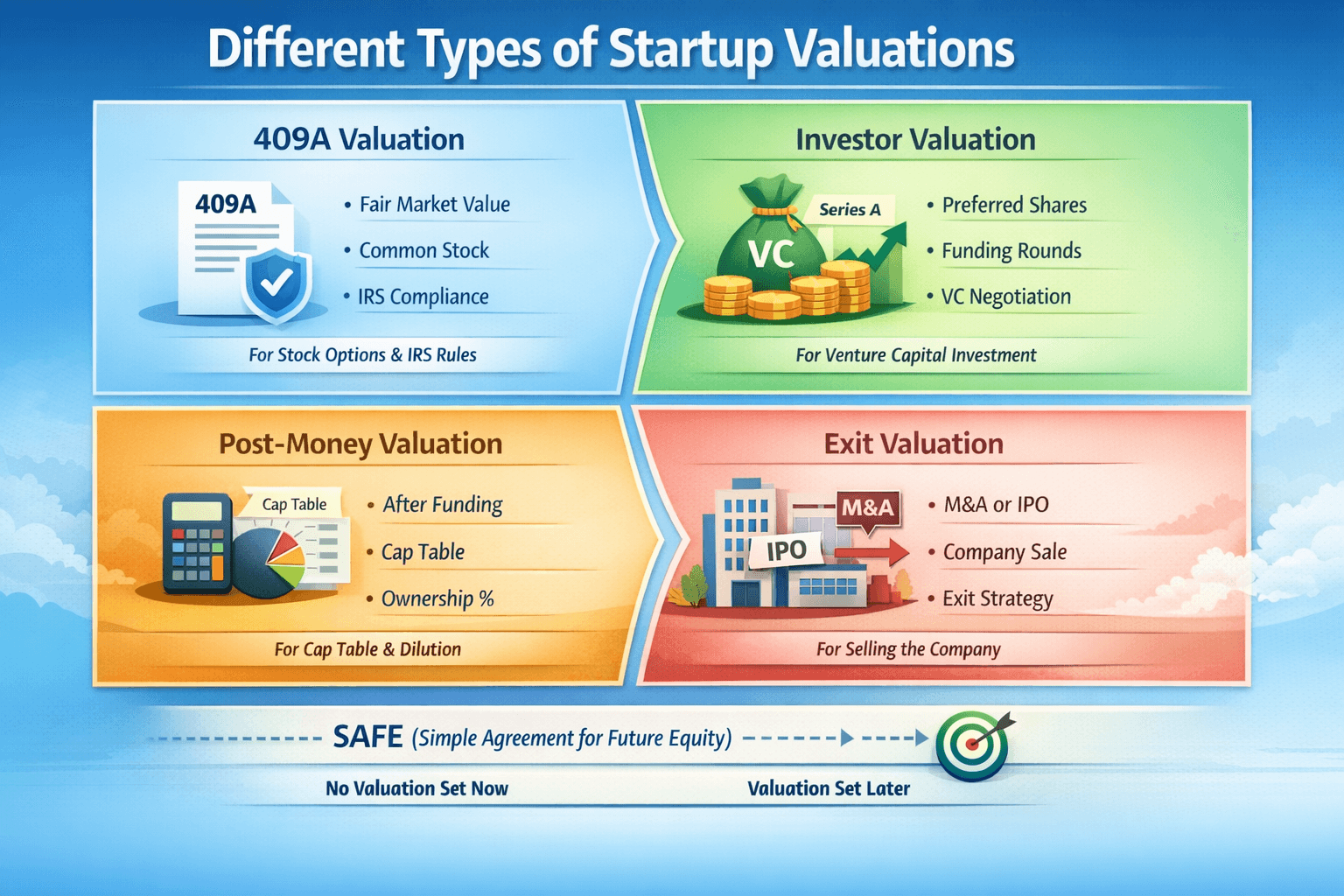
In this article, we break down the main types of startup valuations, explain when each is typically used, and clarify why differences between them are both normal and expected — especially when it comes to 409A valuations.
Get your 409A report free — signed for $499.
Get Started →What Are the Different Types of Startup Valuations?
| Concept | Is It a Valuation? | When Used | Primary Purpose |
|---|---|---|---|
| 409A Valuation | Yes | Before issuing equity | IRS tax compliance |
| Investor (Preferred) Valuation | Yes | Priced funding rounds | Pricing preferred shares |
| Post-Money Valuation | Yes | After a financing round | Ownership & dilution clarity |
| Common Stock Valuation | Yes | Equity compensation | Employee equity pricing |
| Exit Valuation | Yes | M&A or IPO | Company sale price |
| SAFE | No | Early fundraising | Defers valuation |
1. What Is a 409A Valuation and When Is It Required?
A 409A valuation determines the fair market value (FMV) of common stock for U.S. tax purposes.
When Is a 409A Valuation Used?
- Before issuing stock options or RSUs
- After major events (fundraising, revenue changes, M&A activity)
- At least once every 12 months (or sooner if triggered)
Why Does the IRS Require a 409A?
The IRS requires companies to price employee equity at fair market value to avoid hidden compensation and tax penalties.
What Are the Key Characteristics of a 409A?
- Regulated and compliance-driven
- Focuses on common stock, not preferred
- Usually lower than investor valuations
- Provides safe-harbor protection when done properly
If you want a deeper explanation, see our full guide: 409A Valuation Overview, 409A Valuation vs Preferred Share Price, and When to Update Your 409A Valuation.
2. What Is an Investor (Preferred Share) Valuation?
This is the valuation most founders think of first — the one announced after a funding round.
When Is an Investor Valuation Used?
- During priced equity rounds (Seed, Series A, Series B, etc.)
What Does an Investor Valuation Represent?
- The negotiated price investors are willing to pay for preferred shares
- Often expressed as a pre-money or post-money valuation
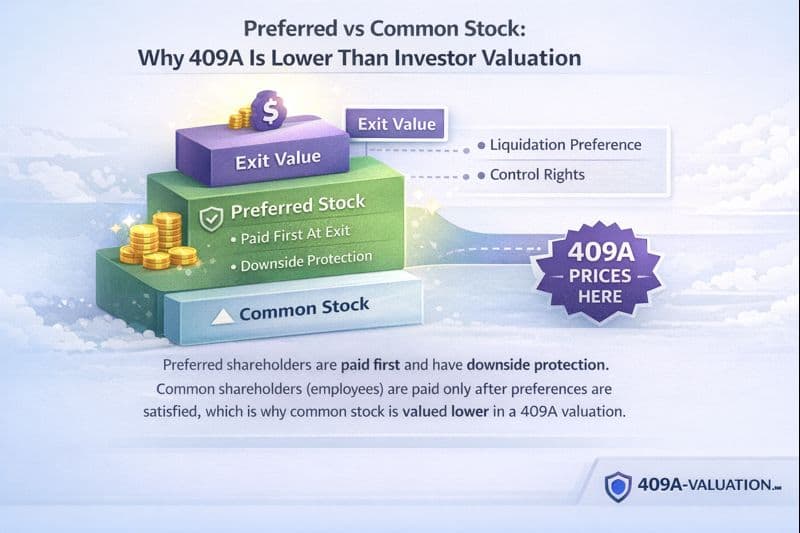
Why Is an Investor Valuation Different from a 409A?
Preferred shares usually include:
- Liquidation preferences
- Downside protection
- Control rights
- Anti-dilution provisions
These features increase value — but they do not apply to common stock, which is why investor valuations are not appropriate for employee equity pricing. This difference is explored in detail here: Why 409A Valuations Are Lower Than Investor Valuations.
3. What Is a Post-Money Valuation and Why Does It Matter?
A post-money valuation is simply:
Pre-money valuation + new capital raised = Post-money valuation
When Is a Post-Money Valuation Used?
- Immediately after a funding round closes
Why Does Post-Money Valuation Matter?
- Determines ownership percentages
- Impacts dilution calculations
- Used for cap table modeling
Importantly, post-money valuation is not used for tax compliance and has no role in determining option strike prices.
4. What Is a Common Stock Valuation and How Is It Used?
While closely related to a 409A, it's worth calling out separately.
When Is a Common Stock Valuation Used?
- Issuing stock options to employees and advisors
- Designing equity compensation plans
Why Is Common Stock Valuation Distinct from Other Valuations?
Common stock:
- Sits at the bottom of the capital stack
- Has no liquidation preference
- Bears the most risk
A properly conducted 409A valuation determines this value using accepted valuation methodologies and IRS guidance.
5. What Is an Exit Valuation and When Does It Apply?
This is the valuation everyone hopes to reach — but it's fundamentally different from all others.
When Is an Exit Valuation Used?
- Company sale
- Merger
- IPO pricing
What Does an Exit Valuation Represent?
- The price a buyer or public market is willing to pay
- Driven by market conditions, strategic value, and growth expectations
Exit valuations are outcomes, not compliance tools, and are irrelevant for option pricing or tax purposes.
6. Why Is a SAFE Not a Valuation — and Why Does That Matter?
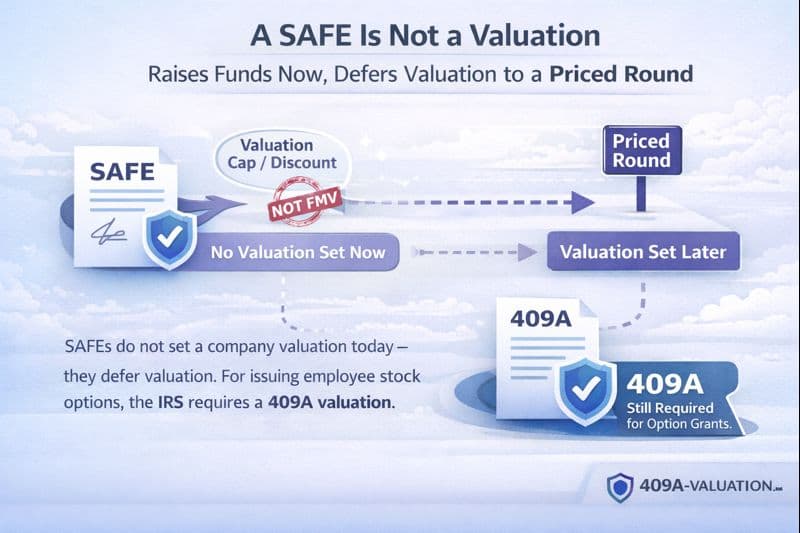
A SAFE (Simple Agreement for Future Equity) is not a valuation — by design.
What Does a SAFE Actually Do?
- Allows startups to raise capital without setting a valuation today
- Defers valuation until a future priced round
What Are the Common Misconceptions About SAFEs?
- A SAFE valuation cap is not your company's current valuation
- A SAFE does not replace a 409A valuation
- Discounts and caps do not establish fair market value
Why Does the SAFE-Valuation Distinction Matter for Founders?
Many founders assume that raising on a SAFE eliminates the need for a 409A.
It does not.
If you issue equity compensation, the IRS still requires a fair market value determination — regardless of how you raised capital.
Why Don't These Startup Valuations Match Each Other?
Different valuations exist because they answer different questions:
- Investors ask: What return can I make?
- The IRS asks: What is the fair market value today?
- Employees ask: What price am I paying for equity?
Trying to force one valuation to serve all purposes leads to confusion — and often compliance risk.
Which Startup Valuation Matters Most — and When?
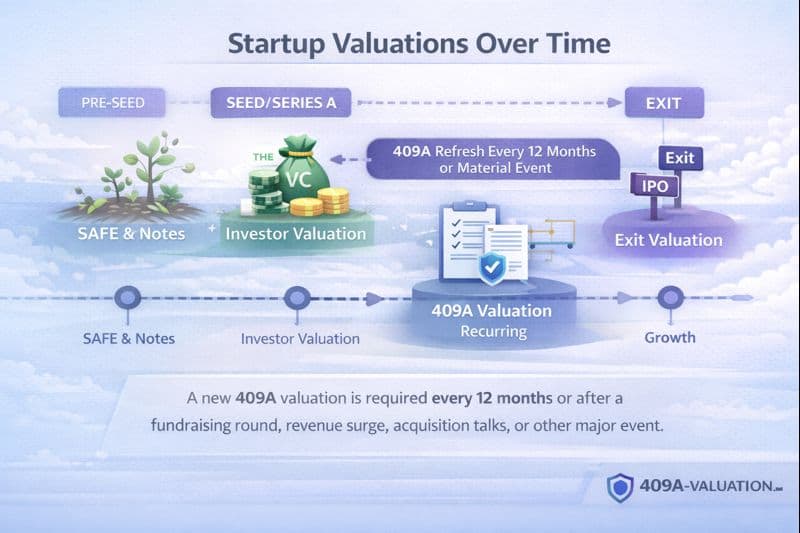
- Issuing employee equity? You need a 409A valuation
- Raising capital? Investor valuation applies
- Using SAFEs? Valuation is deferred, not eliminated
- Selling the company? Exit valuation governs
Understanding the distinction helps founders:
- Avoid IRS penalties
- Set fair option prices
- Communicate clearly with employees and investors
What Should Founders Know About Using the Right Valuation?
Valuation confusion is one of the most common (and stressful) issues founders face — especially as companies grow and mature.
The key takeaway is simple:
Different valuations serve different purposes — and none of them are "wrong" in context.
If you're issuing equity or planning to do so, make sure the valuation you rely on is the one the IRS actually cares about.
Learn more in our 409A Valuation Guide or explore additional articles in our Insights Library.

Need a 409A Valuation?
Get a compliant, defensible 409A valuation with fast turnaround and expert review.
Get Started Today