
Affordable 409A Valuations: How AI Reduces Cost While Improving Compliance, Reliability, and Credibility
How AI Reduces Cost While Improving Compliance, Reliability, and Credibility
Short answer: An affordable 409A valuation starts at $499 with AI-powered platforms that produce IRS safe harbor-eligible reports signed by credentialed appraisers — the same methodology and audit defensibility as traditional firms at 90% lower cost.
An affordable 409A valuation in 2026 starts at $499 with AI-enabled platforms that produce IRS-safe-harbor reports signed by credentialed appraisers — well below the $2,500–$15,000 charged by traditional firms. Affordable does not mean low quality: modern platforms use the same OPM/Backsolve methodology, same DLOM models, and same audit-defense documentation as expensive firms. The savings come from automation, not corner-cutting.
Yet 409A valuations play a critical role. They protect companies, employees, and boards by ensuring that equity compensation is granted at fair market value, in line with IRS regulations. When done properly, they reduce tax risk, support clean audits, and provide defensible documentation for future transactions.
So why do they feel so painful?
After more than two decades conducting company valuations and 409A valuations across venture-backed startups, growth-stage companies, and mature organizations, the answer is clear: the problem is not the regulation — it is the process.
Historically, 409A valuations have relied on labor-intensive, manual workflows that have not evolved alongside technology. Today, AI and automation are fundamentally changing that reality, making affordable 409A valuations possible without compromising compliance, credibility, or audit defensibility.
To see what you'd actually pay, get your 409A report free — and if you need an expert to sign off for IRS safe harbor, it's just $499, with no hidden fees or rush charges.
What Is the True Purpose of a 409A Valuation, and Why Does It Matter?
Before discussing cost or efficiency, it's worth revisiting what a 409A valuation is actually meant to achieve.
A 409A valuation determines the fair market value (FMV) of common stock for purposes of granting equity compensation. It must reflect:
- The company's financial condition
- Its capital structure
- The rights and preferences of preferred shareholders
- Market conditions and comparable data
- Reasonable exit scenarios
Importantly, the value of common stock is not the same as the price paid by investors in preferred rounds. This distinction is foundational to 409A methodology and often misunderstood by founders. (See 409A Valuation vs Preferred Share Price: Why They're Different for a detailed explanation.)
A proper 409A valuation is therefore not a shortcut exercise. It requires structured analysis, consistent methodology, and professional judgment. What has changed is how efficiently this work can be performed.
How Do Traditional and AI-Enabled 409A Valuation Workflows Actually Differ?
Before examining cost, it's essential to understand where time and effort are actually spent in a 409A valuation.
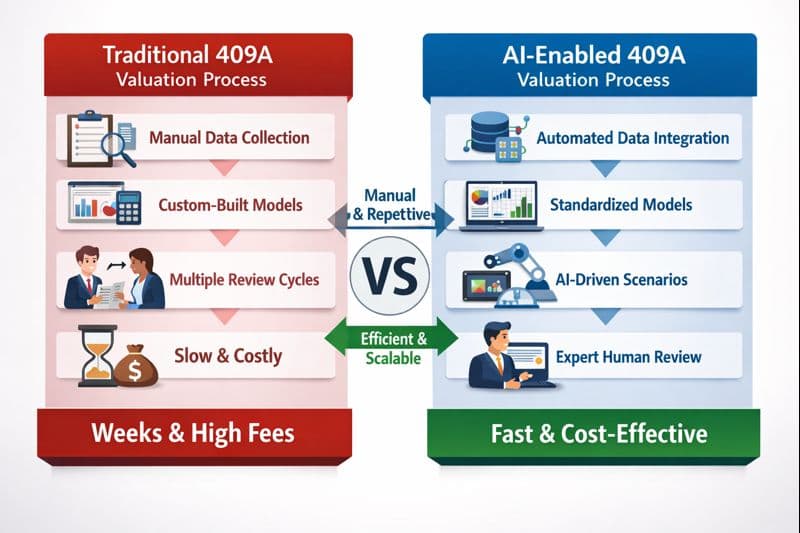
In a traditional workflow, much of the process revolves around manual effort. Analysts collect information from multiple sources, normalize inconsistent data, rebuild valuation models from scratch, and perform sequential reviews. Each step depends on the completion of the previous one, which introduces delays and limits scalability.
Modern AI-enabled workflows approach the same requirements very differently. Structured data ingestion, standardized modeling logic, and automated scenario analysis dramatically reduce the time spent on repetitive tasks. Human experts remain deeply involved, but their focus shifts toward reviewing assumptions, assessing reasonableness, and ensuring defensibility rather than rebuilding mechanics.
The outcome is not simply speed. It is a fundamentally more efficient allocation of expertise.
Why Do Traditional 409A Valuations Cost So Much?
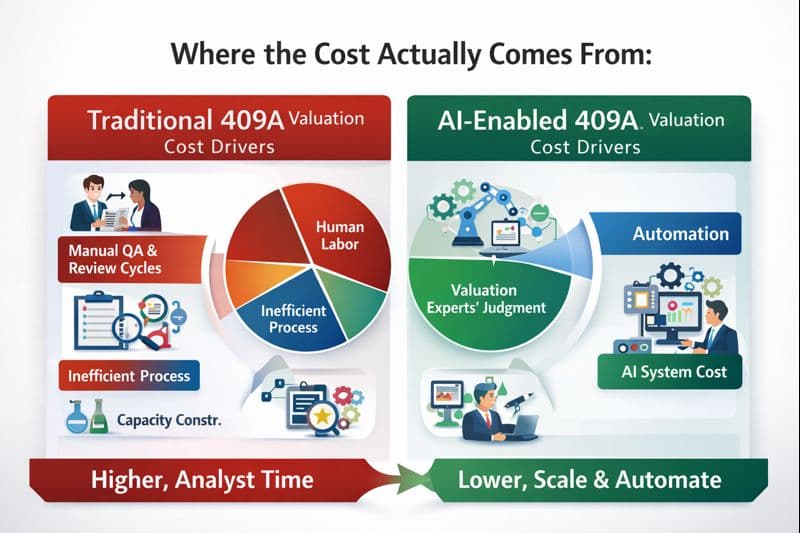
The high cost of traditional 409A valuations is often misunderstood. Many assume it reflects complexity or regulatory burden. In reality, it primarily reflects how analyst time is consumed.
In a conventional valuation firm, senior analysts and managers spend significant hours on tasks that are largely mechanical:
- Reformatting cap tables and equity schedules
- Translating financing documents into capital stack models
- Rebuilding option-pricing and waterfall models engagement by engagement
- Running similar scenarios repeatedly across similar companies
- Performing manual consistency checks and quality assurance
Because these tasks require trained professionals and occur sequentially, costs scale with hours worked rather than analytical insight. As a result:
- Even relatively straightforward seed-stage companies often face fees in the thousands
- Turnaround times extend into weeks
- Option grants are delayed, creating operational friction
None of this improves compliance or accuracy. It simply reflects outdated process design.
For a broader overview of the regulatory and methodological foundation behind these requirements, see 409A Valuation Explained: Requirements, Process, and Cost. For current pricing benchmarks, see our 409A Valuation Cost Guide. For guidance on evaluating different provider types, see our guide on 409A valuation services.
Does "Affordable" Mean Lower Quality in a 409A Valuation?
The word "affordable" often raises concern in regulated contexts. Founders and CFOs rightly worry that lower cost might imply reduced rigor, weaker documentation, or increased audit risk.
This concern is understandable — but it is rooted in an outdated assumption: that quality is proportional to manual effort.
In reality, quality in a 409A valuation depends on:
- Appropriate methodology
- Reasonable and supportable assumptions
- Correct treatment of the capital structure
- Clear documentation and transparency
None of these require excessive manual repetition. In fact, manual processes often increase risk by introducing inconsistency and human error. Affordability today is not about doing less work. It is about doing the right work, efficiently.
How Does AI Improve the 409A Process Beyond Just Speeding It Up?
AI is often framed as a speed enhancer, but its real impact on 409A valuations is structural improvement.
Data Integrity and Consistency
AI-enabled systems can ingest cap tables, financial statements, and transaction history in structured formats, applying validation rules automatically. This reduces the risk of transcription errors and ensures consistency across inputs.
Because data handling is standardized, assumptions are easier to trace and review — an important consideration for auditors and boards.
Methodological Discipline
Valuation methodologies such as OPM, PWERM, and hybrid approaches involve precise logic around probability weighting, payoff allocation, and scenario modeling. When these are implemented manually, small differences in setup can lead to inconsistent outcomes.
AI systems apply these frameworks consistently, ensuring:
- Uniform treatment of liquidation preferences
- Accurate modeling of participation features
- Repeatable scenario analysis
This consistency strengthens defensibility and reduces reliance on individual analyst interpretation. (For a deeper dive, see Option Pricing Model (OPM) Explained.)
Focused Human Judgment
Crucially, AI does not eliminate human involvement. Instead, it reallocates expertise. Valuation professionals spend their time reviewing assumptions, assessing reasonableness, and applying judgment where it truly matters. This improves both efficiency and quality.
Why Is Common Stock Valuation Especially Sensitive to Methodology?
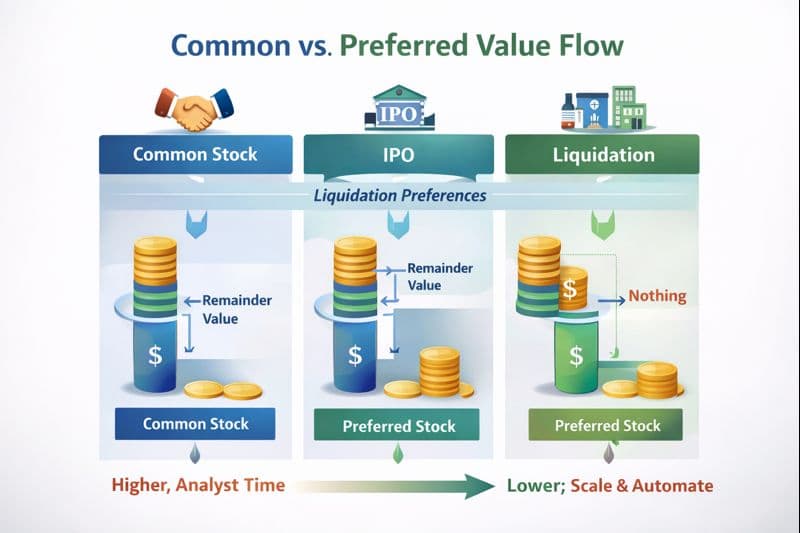
One of the most common sources of confusion in 409A valuations is the relationship between preferred and common stock value.
Preferred investors benefit from liquidation preferences, downside protection, and other rights that materially affect payout distribution. Common shareholders participate only in the residual value after these preferences are satisfied.
Accurately modeling this relationship is essential. Errors here can materially misstate common stock value and create tax exposure. AI-enabled modeling improves precision by:
- Enforcing correct capital stack logic
- Applying scenario-based payoffs consistently
- Reducing manual modeling errors
This is an area where automation reduces risk rather than introducing it. (See 409A Valuation vs Preferred Share Price: Why They're Different for a detailed explanation.)
Can an Affordable 409A Valuation Actually Deliver Higher Quality Than a Traditional One?
In practice, many AI-assisted valuations demonstrate higher overall quality than traditional engagements. Well-designed processes:
- Reduce manual errors
- Improve internal consistency
- Create clearer documentation trails
- Support easier audit review
Quality is enhanced when systems enforce discipline and professionals focus on judgment rather than mechanics.
How Does AI Strengthen Compliance, Reliability, and Credibility in a 409A Report?
When implemented responsibly, AI strengthens the three pillars that matter most in a 409A valuation:
- Compliance: Required methodologies, disclosures, and assumptions are consistently applied and documented.
- Reliability: Standardized logic reduces variability and error, improving repeatability across valuation updates.
- Credibility: Clear, transparent outputs improve confidence for auditors, boards, and tax advisors.
For startups that grant options frequently, this leads to smoother operations and reduced distraction for finance teams.
When Do Affordable 409A Valuations Make the Most Sense for Your Company?
Affordable, AI-enabled 409A valuations are particularly well-suited for:
- Seed to Series B startups where cost efficiency matters and capital structures are relatively straightforward
- Companies with frequent option grants who need fast, predictable turnaround
- International or non-US startups with US equity plans who benefit from standardized, automated processes (see Why Startup Founders Should Care About 409A Valuations)
- CFOs seeking predictable pricing and turnaround times to reduce administrative friction
For more on how 409A valuations are priced across different providers, see 409A Valuation Cost in 2026: Complete Pricing Guide.
What Long-Term Benefits Do Modern 409A Platforms Deliver Beyond Immediate Cost Savings?
The benefits of modern 409A processes extend beyond immediate savings. Companies gain:
- Faster option grant cycles
- Lower operational friction
- Better preparedness for audits and diligence
- Cleaner historical valuation records
Over time, this contributes to stronger governance and smoother fundraising or exit processes. For guidance on timing, see When to Update Your 409A Valuation.
What Is the Bottom Line on Affordable 409A Valuations?
After decades in valuation, one conclusion stands out: the principles of 409A compliance have remained stable, but the tools we use should evolve.
Affordable 409A valuations are not about reducing standards. They are about leveraging technology to apply those standards more consistently, transparently, and efficiently.
For modern startups, this approach aligns compliance with the pace of innovation — without sacrificing credibility or rigor. For a comprehensive overview of the entire 409A process, see our Complete 409A Valuation Guide for Startups.
Frequently Asked Questions (FAQ)
What is an "affordable" 409A valuation?
An affordable 409A valuation is one that uses AI and automation to reduce the time and cost of the process, while still applying rigorous methodology and expert oversight. Affordability reflects improved efficiency — not reduced rigor.
Are AI-enabled 409A valuations IRS compliant?
Yes. The methodology, documentation, and assumptions in an AI-enabled 409A valuation follow the same IRS and AICPA standards as traditional valuations. The difference is how efficiently those standards are applied.
Do auditors accept AI-assisted 409A valuations?
Yes. What auditors evaluate is the defensibility of assumptions, consistency of methodology, and clarity of documentation — not whether tools were used. AI-assisted valuations often provide cleaner documentation trails, making audits easier.
Is human judgment still involved?
Absolutely. AI handles data processing and mechanical calculations. Experienced valuation professionals review assumptions, assess reasonableness, and finalize conclusions. The result is a more efficient use of expert time, not its replacement.
Can AI reduce valuation errors?
Yes. Manual processes introduce variability and transcription errors. AI systems enforce consistency, apply standardized logic, and reduce the risk of mistakes that often go unnoticed in traditional workflows.

Ready for a Smarter 409A Valuation?
Get a compliant, affordable 409A valuation with AI-powered efficiency and expert oversight.